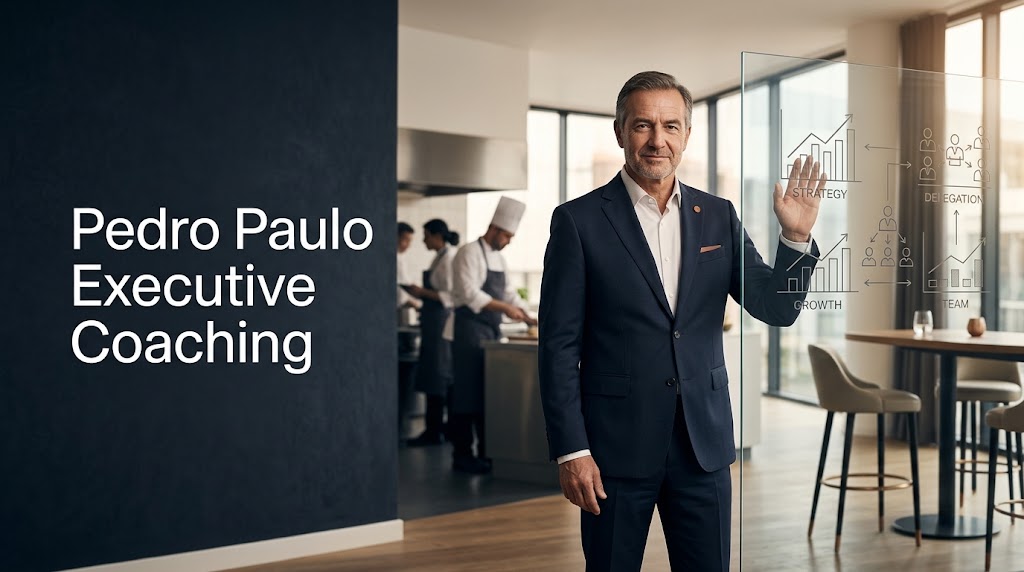
Pedro Paulo Executive Coaching is a specialized leadership development approach designed to help executives, founders, chefs, restaurant owners, and hospitality professionals become stronger leaders while improving business performance. Its key difference is the blend of personal coaching and practical business consulting.
Instead of focusing only on mindset or career goals, the approach connects leadership behavior with real operational problems. This can include delegation, team communication, business growth, stress management, strategic planning, and the shift from doing every task yourself to leading the people and systems around you.
What Is Pedro Paulo Executive Coaching?
Pedro Paulo Executive Coaching is a structured leadership development program that combines executive coaching with business strategy. The model is particularly relevant to food, hospitality, restaurant, and food production professionals working in high-pressure environments.
Traditional executive coaching may focus mainly on personal behavior, communication, confidence, or career development. Pedro Paulo’s approach adds an operational layer, helping leaders connect personal improvement with practical business decisions.
This matters because a restaurant leader can become more confident without becoming more effective. Real leadership improvement should also appear in team performance, delegation, decision-making, staff retention, customer experience, and business operations.
Who Is Pedro Paulo Executive Coaching For?
The program is especially relevant to people whose careers combine leadership and demanding operational work. This includes executive chefs, restaurant owners, hospitality founders, general managers, sommeliers, food entrepreneurs, and food production executives.
It can also suit professionals moving into larger leadership roles. A talented chef, for example, may be excellent at cooking but struggle when suddenly responsible for hiring, delegation, budgets, culture, and several managers.
The same issue can affect a successful restaurant owner. The skills needed to open one location are not always the skills required to lead several locations. Executive coaching can help bridge that leadership gap.
Why Hospitality Leaders Need a Different Coaching Approach
Hospitality is different from many office-based industries. Leaders often work under intense time pressure while dealing with customers, staff shortages, tight margins, changing demand, and unpredictable service problems.
A leadership decision may need to be made in seconds during a busy dinner service. At the same time, the owner must think about staffing, food costs, expansion, marketing, and long-term profitability.
This creates a common problem: leaders become trapped inside daily operations. They spend so much time solving immediate problems that they have little time to build systems, develop managers, or plan the future.
From Working in the Business to Working on the Business
One of the most important ideas behind Pedro Paulo Executive Coaching is the difference between working in a business and working on a business.
Working in the business means personally handling problems, approving every decision, solving staff issues, and becoming the person everyone depends on. This may work for a small operation, but it becomes difficult as the company grows.
Working on the business means building capable teams, creating clear systems, delegating responsibility, and spending more time on strategy. The goal is not to become less involved. It is to become involved at the right level.
The Coaching and Consulting Combination
The hybrid nature of Pedro Paulo Executive Coaching is one of its most notable features. Coaching generally helps a leader understand behavior, beliefs, habits, communication patterns, and decision-making.
Consulting, on the other hand, focuses more directly on business problems and possible solutions. Combining the two can help a leader understand both why a problem exists and what needs to change operationally.
For example, a restaurant owner may know that delegation is necessary but still refuse to give managers real authority. Coaching can explore the reason behind that behavior, while business strategy can help create a safer delegation structure.
Key Leadership Challenges It Can Address
Imposter syndrome is one common challenge among high-performing professionals. A chef promoted into an executive role may suddenly question whether they are ready to lead people instead of simply producing excellent food.
Delegation is another major issue. Leaders who believe they must personally control every detail can become exhausted while limiting their team’s growth.
Rapid scaling creates another challenge. When a restaurant, food brand, or hospitality company expands, informal management habits often stop working. Leaders need clearer roles, stronger communication, better processes, and more strategic thinking.
High stress and employee turnover can also create a cycle of constant firefighting. Stronger leadership habits can help create a calmer and more accountable working environment.
How the Leadership Development Process Works
A useful coaching relationship normally begins with identifying the leader’s current situation. This means understanding goals, strengths, weaknesses, business pressures, team dynamics, and the specific outcomes the client wants.
The next stage is turning broad goals into practical actions. Instead of simply saying, “I want to become a better leader,” the client might work toward clearer delegation, better one-to-one meetings, improved decision-making, or stronger team accountability.
Progress can then be reviewed over time. The focus is not just on what the leader learned during a coaching session but on whether new behaviors appear in the workplace.
A Practical Framework for Measuring Progress
Leadership development becomes more useful when progress can be observed. Personal feelings matter, but measurable changes provide stronger evidence of improvement.
| Area | Possible Measurement |
|---|---|
| Leadership | Confidence, decision quality, delegation |
| Team | Engagement, communication, retention |
| Operations | Productivity, service efficiency, consistency |
| Business | Revenue, margins, costs, growth |
| Culture | Trust, accountability, collaboration |
The exact measurements should depend on the organization. A restaurant opening its third location may care about management structure and consistency, while a food startup may focus more on scaling and founder delegation.
Expected Results and Timeline
According to information published about the program, behavioral and leadership changes may begin appearing within approximately eight weeks. This should not be interpreted as a guarantee, because coaching results depend heavily on the leader, organization, goals, and level of implementation.
Larger organizational changes generally require more time. The supplied program information points to approximately six months for structural and measurable operational impact.
This timeline makes sense when viewed realistically. Changing a habit can happen quickly, but changing a team culture, management structure, or business process usually requires repeated practice and follow-through.
Pedro Paulo Executive Coaching Pricing and Tiers
Reported program pricing ranges from approximately $4,500 to $30,000, depending on the level and scope of engagement. The available descriptions identify Base, Professional, and Platinum-style tiers.
The important point is that executive coaching should not be judged by price alone. A lower-cost program may be enough for an emerging manager with one clear leadership challenge, while a founder managing major growth may need deeper and longer-term support.
Before committing, potential clients should confirm exactly what each tier includes, how often sessions occur, whether team coaching is included, what consulting support is available, and how progress will be measured.
What Makes the Program Different?
The strongest differentiator is its industry-aware perspective. Generic leadership advice can be useful, but restaurant and hospitality leaders often face problems that require more practical context.
A chef cannot simply remove every stressful situation from a busy service. A restaurant owner cannot delegate everything without creating clear accountability. A hospitality founder cannot scale successfully without changing how they personally operate.
The coaching model attempts to address these realities by combining leadership development with business execution.
Potential Benefits for Restaurant Owners
Restaurant owners may benefit from learning how to delegate more effectively and create stronger management layers. This can reduce the pressure of being the person who handles every problem.
Better strategic thinking can also help owners spend more time on growth, financial planning, customer experience, brand development, and long-term decisions.
The biggest benefit may be leadership independence. A healthy organization should not stop functioning whenever its owner leaves the building.
Potential Benefits for Executive Chefs
Executive chefs often move into leadership after becoming highly skilled in their craft. However, managing people requires a different set of abilities.
An executive chef must communicate expectations, develop other chefs, resolve conflict, delegate responsibilities, and maintain standards without creating unnecessary fear or pressure.
Coaching can help bridge the gap between technical excellence and people leadership. That shift can be especially valuable when a chef moves from managing a kitchen to overseeing multiple teams or locations.
Potential Benefits for Hospitality Founders
Founders often become the center of every decision. This can help a young company move quickly, but it can become a serious limitation during growth.
Executive coaching can help founders identify which responsibilities truly require their attention. It can also help them build trust in managers and create systems that allow the company to operate without constant founder intervention.
This is especially important during expansion, fundraising, new-location launches, or major organizational changes.
How to Evaluate the Program Before Paying
Potential clients should approach any executive coaching investment with careful questions. Ask what the program includes, who delivers the coaching, how goals are established, how progress is measured, and what support exists between sessions.
It is also useful to ask for clear explanations of reported results. Claims about ROI, promotions, productivity, or leadership improvement should be understood in context rather than treated as guaranteed outcomes.
A good coaching decision should consider the coach’s experience, methodology, industry knowledge, communication style, program structure, cost, and measurable objectives.
Is the Reported ROI Realistic?
Reported information associated with Pedro Paulo Executive Coaching cites a 788% average ROI benchmark and says that 95% of participants report significant improvement in leadership effectiveness. These figures should be treated as reported program data rather than a promise that every client will achieve the same return.
ROI from coaching can be difficult to isolate because business performance has many causes. Revenue may rise because of better marketing, stronger demand, improved pricing, or market changes at the same time leadership improves.
For this reason, the strongest evaluation method is to establish baseline metrics before coaching begins and compare them with clearly defined outcomes later.
Strengths and Limitations to Consider
The program’s main strength is its attempt to connect personal leadership development with real business operations. This makes the approach especially relevant to leaders who need practical change rather than motivational advice alone.
The main limitation is that coaching cannot replace good business fundamentals. A restaurant with serious financial problems, poor products, weak market demand, or major operational failures may require specialized accounting, legal, financial, or operational professionals as well.
Coaching works best when the leader is willing to examine their behavior and consistently apply what they learn.
Frequently Asked Questions
What is Pedro Paulo Executive Coaching?
Pedro Paulo Executive Coaching is a leadership development approach that combines executive coaching with practical business strategy. It is particularly focused on leaders in restaurants, hospitality, food production, and related industries. The goal is to improve leadership behavior while connecting those changes to team and business performance.
Who can benefit from Pedro Paulo Executive Coaching?
The program is primarily suited to chefs, restaurant owners, hospitality founders, sommeliers, food entrepreneurs, executive managers, and professionals moving into larger leadership roles. It can be especially useful for people dealing with delegation problems, rapid growth, workplace stress, imposter syndrome, team challenges, or the demands of managing a larger operation.
How much does Pedro Paulo Executive Coaching cost?
Reported pricing ranges from approximately $4,500 to $30,000, depending on the selected program tier and amount of coaching or consulting support required. Prospective clients should confirm the current price, duration, included services, session frequency, and payment terms before making an investment.
How quickly can coaching produce results?
Reported program information suggests that noticeable behavioral changes may appear within about eight weeks, while broader organizational changes can take around six months. Actual results vary by client. Leadership improvement requires practice, feedback, accountability, and consistent application inside the workplace.
Is Pedro Paulo Executive Coaching worth it?
It may be worthwhile for leaders facing significant management or growth challenges where improved leadership could create measurable business value. However, clients should evaluate the cost against their goals, expected outcomes, available evidence, and personal commitment. Clear metrics and defined objectives can make the investment easier to assess.
Final Verdict on Pedro Paulo Executive Coaching
Pedro Paulo Executive Coaching stands out because it does not treat leadership as a purely personal development exercise. Its central idea is to connect mindset, behavior, leadership skills, and operational business performance.
For restaurant owners, chefs, hospitality founders, and food-industry executives, this combination can be particularly relevant. These leaders must manage people and pressure while also protecting quality, profitability, culture, and growth.
The reported pricing and outcomes make it an investment that deserves careful evaluation rather than an impulse decision. The best approach is to define measurable goals, understand the program tier, verify what is included, and track results from the beginning.
Ultimately, executive coaching is most valuable when insight becomes action. For leaders ready to delegate better, think more strategically, develop stronger teams, and move from daily firefighting toward long-term leadership, Pedro Paulo Executive Coaching offers a distinctive coaching-and-consulting model worth examining.
About the Author


